Why Customer Support Software Is Still Built for the Wrong Buyer

Dawson Chen
There are hundreds of customer support tools on the market. Legacy helpdesks, AI-powered platforms, chatbot builders, ticketing systems. And yet, if you're a startup founder trying to set up support for the first time, almost none of them feel like they were made for you.
That's because they weren't.
Zendesk Was Built for the VP of Support
Zendesk, Intercom, Freshdesk, Helpscout: these are mature products built for mature support organizations. Their buyer is someone with a team, a budget, and a reporting structure. A VP of Support. A Head of CX.
The feature set reflects that. Ticket routing rules. SLA management. Agent performance dashboards. QA workflows. Workforce management integrations. These are valuable features if you have 20 agents and need to manage them. They're useless overhead if you're a founder handling tickets between product meetings.
Setting up Zendesk properly takes time. You configure views, macros, automations, triggers. You build out your help center. You define escalation paths. For a team that's already running support at scale, this pays off. For a three-person startup, it's a week of configuration for a tool you'll outgrow or rip out within a year.
The New AI Tools Are Still Enterprise-First
The latest wave of AI support companies, Decagon, Sierra, Forethought, Cognigy, are building genuinely impressive products. Full AI agents that can resolve tickets end-to-end. Deep integrations with internal systems. Custom workflows and guardrails.
But look at who they sell to. Their landing pages feature logos from large companies. Their sales process involves demos, pilots, and forward-deployed engineers. Implementation takes weeks or months. Pricing starts in the thousands per month.
This makes sense for their business model. Enterprise contracts are large and sticky. But it leaves a massive gap in the market.
If you're a 5-person startup doing 50 tickets a day, you can't run a 6-week pilot with a dedicated implementation engineer. You need something that works in 15 minutes.
The Missing Layer: Founder-First Tooling
Here's what the market looks like:
| Stage | Tool | Buyer |
|---|---|---|
| Enterprise | Decagon, Sierra, Cognigy | VP of Support, CTO |
| Mid-market | Zendesk, Intercom, Freshdesk | Head of CX, Support Manager |
| Startup | ??? | Founder |
The startup row is empty. Founders cobble together solutions: a shared Gmail inbox, a basic helpdesk they barely configure, maybe a VA they onboard with a Google Doc. It works until it doesn't.
The reason nobody has built for this buyer is that startups are a hard market. Low ACV. High churn. The founder who needs support tooling today might not be a customer in six months because the company failed, pivoted, or outgrew the tool.
But that framing misses what makes startups valuable as a market. Founders are fast decision-makers. They adopt tools in minutes if the tool works. And the ones who succeed become mid-market companies that stick around for years.
What Founder-First Support Looks Like
A support tool built for founders would look different from what's on the market today:
Setup in minutes. Connect your email, your database, your Stripe account. No configuration wizard. No week of onboarding.
AI that works immediately. The AI should draft replies from the first ticket, using your actual customer data. No months of training or manual tagging.
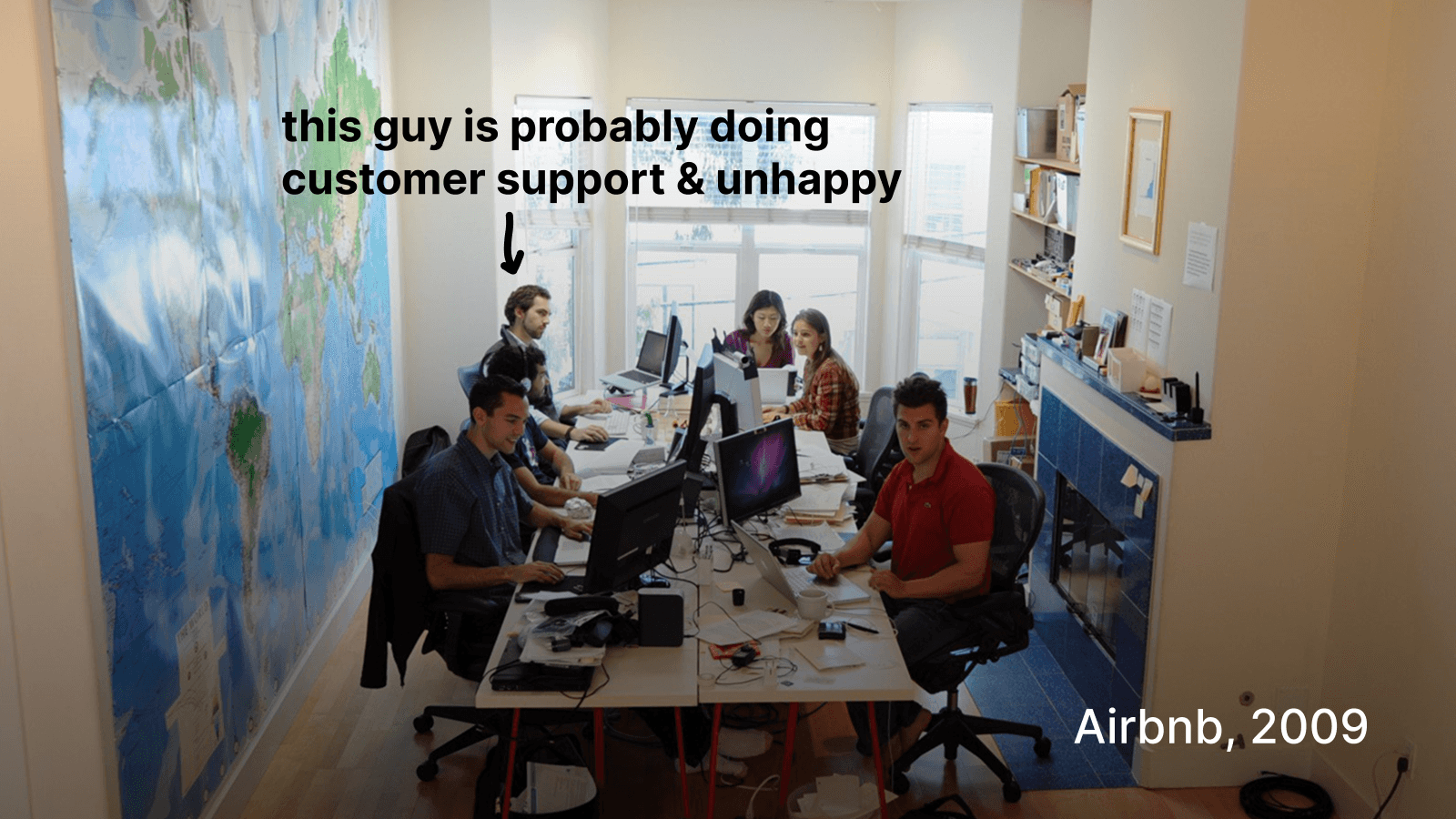
One person can run it. The tool should make it possible for a single person, the founder, an early employee, a part-time VA, to handle all of support.
Grows with you. When you hire your first support agent, the tool should make onboarding easier. When volume doubles, the AI should handle more, not less.
Full control. Every AI-drafted reply goes through a human before it's sent. The founder stays in the loop on every customer interaction.
This is what we're building at Letterbook. We watched founders struggle with tools that were designed for someone else, and we decided to build the support platform that should have existed from the start.
The Bet
Our bet is that the best support tool for startups isn't a stripped-down version of Zendesk or a cheaper version of Decagon. It's a different product entirely, designed around how founders actually work: fast, hands-on, opinionated, and resource-constrained.
If you're a founder doing support today, you already know what you need. The tools just haven't caught up yet.